Late-diagnosed ADHD in women
The lived experience nobody warns you about: the eighteen-month grief, the rewriting of your own life story, the women in your life who also have it and don't know yet.
Psychology & Self-Help · Adult ADHD · Late Diagnosis
I write psychology and mental-health books for women who were diagnosed with ADHD in their thirties or forties, and are now unlearning twenty years of anxiety, masking, and trying to be neurotypical.
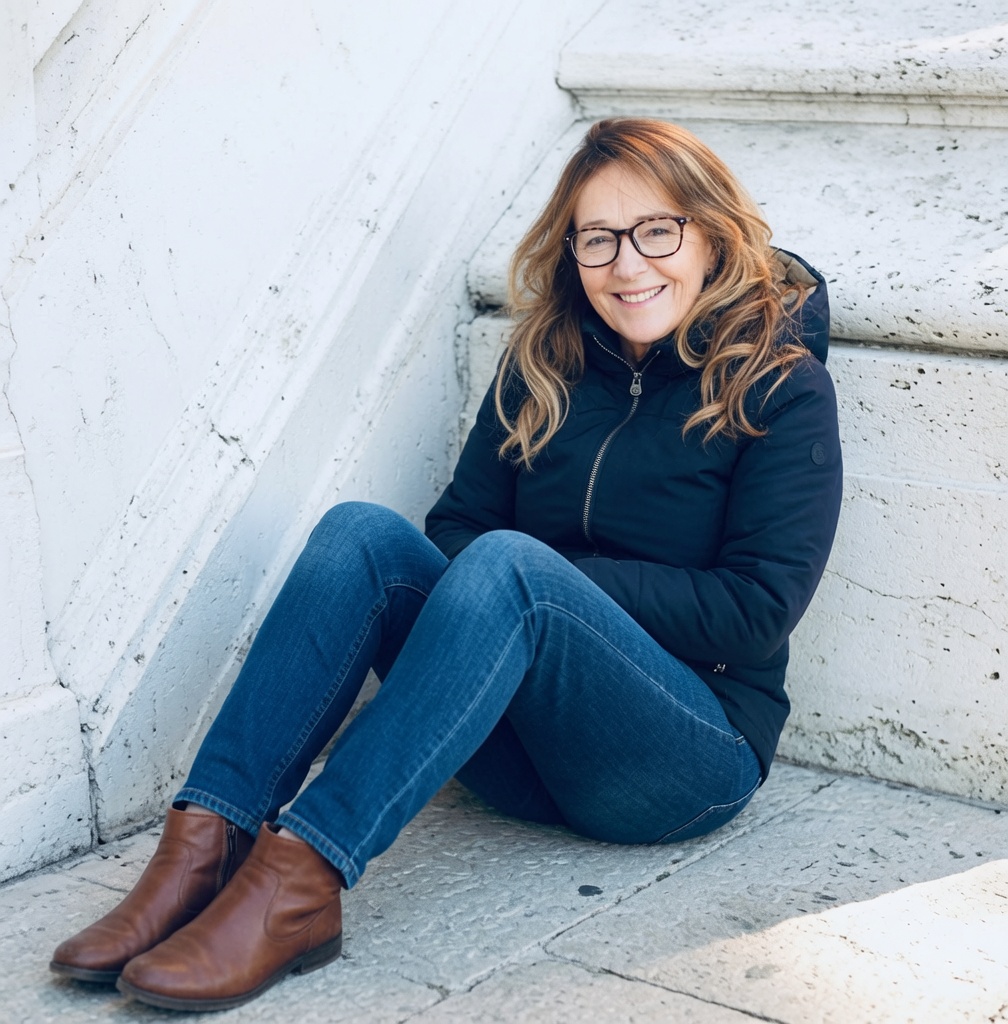
Bologna, 2026.
About
I was thirty-one when a therapist with a kind face and a worn-out cardigan asked me, very gently, if I had ever been evaluated for ADHD.
I laughed. The kind of laugh that buys you four seconds while your nervous system decides what to do next.
I had a master's in psychology. I was running brand strategy at a London consultancy. I had been to seven therapists for what I had spent a decade calling anxiety and what one of them had once called, charitably, a presentation problem. Nobody had ever used the four letters. I did not know that anybody was supposed to.
That conversation was eighteen years ago. I am writing this from a desk in Bologna where I keep two notebooks. One for the work, one for what is left over after the work. The notebooks are color coded, which would once have astonished me, and not in a complimentary way.
This page is the longer version. The shorter version is on the back of every book I write. The shorter version sounds tidier than the longer one, which is the way of shorter versions everywhere.
I grew up in a small town on the Adriatic coast, the daughter of an architect and a librarian. There were books and there were drawings, and almost nothing in between. By the time I was nine I had read four hundred books and finished none of the homework. My teachers wrote intelligente ma distratta on every report card for nine consecutive years, the way one writes the same observation about the weather without ever doing anything about it.
The compliments arrived in pairs. So bright. If only she would apply herself. I learned to hear the second sentence before the first one had finished. I started building a private system, in the back of every notebook, of small bargains with myself about which classes I could fail before the report card would be a problem. The bargains worked, mostly. I graduated near the top of my class on the back of all-nighters that started, the first time, when I was fifteen.
The all-nighters never stopped. They were the shape of my twenties.
I moved to London at twenty-three for a master's in social psychology and a job offer at a research firm that liked the dissertation on identity and compensation behavior. I had written the dissertation in four weeks, during a fever, in what I now know to call a hyperfocus state, and what I then called finally feeling like a real person.
For the next eight years I had two lives in parallel.
The visible life was a strategy career at consultancies that paid better every year. I was good at the work in a way that was almost embarrassing when I was firing, and a way that made me want to disappear when I wasn't. I shipped beautiful decks at 4 a.m. I led teams of people who told me they wished they could think like me. I made partner at thirty.
The invisible life was an inbox with fourteen thousand unread emails, an apartment I cleaned in a panic three hours before guests arrived, a husband who had stopped asking why my replies to him took six days, and a body that had been requesting recovery from me, in increasingly louder ways, since I was twenty-six. I had four prescriptions for anxiety, none of which had ever fully worked, and a private theory that I was the kind of person who simply had to white-knuckle adulthood in a way other women did not.
I spent that decade being congratulated on the visible life and apologizing for the invisible one, and treating the gap between the two as a personal failing that I could close if I tried just a little harder next quarter.
The breakdown, when it came, was unremarkable. I missed a Tuesday morning client call that I had personally insisted on scheduling at that exact time. I had not slept. I had been awake since two doing a deliverable I had had three weeks to start.
The call ended. I did not cry. I sat in a meeting room with no one in it for forty minutes, and then I texted my husband, and then I made the appointment with the therapist with the cardigan, and that is how this whole thing started.
She asked the question about ADHD on our fourth session. She did not press. She wrote a name on a piece of paper, of a specialist she liked.
The evaluation took six hours across two appointments. The diagnosis was not a surprise to her. It was a stranger walking into my living room to me.
I did not feel relief. I felt a particular kind of grief that I have since learned is almost universal in late-diagnosed women, and that nobody had warned me about, and that took eighteen months to metabolize before any of the rest of it could begin.
The grief was for the version of me who had spent twenty-two years thinking she was lazy in a unique and shameful way that the women around her were not. It was for the friendships I had let drift because I could not remember to text back. It was for the version of my marriage that did not include the silence on his side that I had once read as disapproval and now had to consider had also been hurt. It was for the seven therapists who had not asked the question, and the report cards, and the all-nighters, and the apologies. A lot of apologies.
I had a master's in psychology and a deep aversion to clinical textbooks, both of which had to be set aside for what came next.
I read Sari Solden first. Women with Attention Deficit Disorder. I read it across a long weekend in a chair I did not get out of except to make tea. There is a passage near the front in which she describes a thirty-eight-year-old client who looks competent and is dying inside, and I closed the book and cried for ninety minutes, and then I went back and finished it.
Russell Barkley next. The executive function model. The bones underneath the experience.
Then Kathleen Nadeau. Then Patricia Quinn. Then Hallowell and Ratey. Then Tracy Otsuka. Then back to Solden, twice. Then the working papers nobody links to, the obscure 1996 studies, the 2018 meta-analyses, the books written by clinicians for clinicians that I had no business reading and read anyway.
I spent a year in the literature. I built a private wiki. I started, almost by accident, coaching three women I knew through their own diagnoses, because they kept asking me what I had read, and I kept writing them long emails, and at some point the long emails became a thing I was doing every Saturday morning for four hours, and at some other point one of them said, Martina, you should charge for this.
I started coaching formally at thirty-five. I left the consultancy at thirty-seven. By thirty-nine I was working full-time with late-diagnosed women in tech, finance, law, and creative industries. The women who were good at their jobs and quietly drowning in them. The women I had been.
The work taught me what the literature could not.
It taught me that productivity advice aimed at our brains had been so consistently wrong for so long that the wrongness itself was the diagnosis. It taught me that the systems that survived in my clients' lives were never the elegant ones, and almost always the ones that had been forgiven for the missed weeks. It taught me that grief is the first stage of every late diagnosis and almost nobody is warned about it.
It taught me, most of all, that what late-diagnosed women need is not more information. They have consumed enough information. They need permission, and structure, and a system that absorbs the imperfect weeks instead of punishing them.
I called what I built calibration, because cure was a lie and hack was an insult and journey was a word I refused to use without scare quotes.
I write the books I wish someone had handed me at thirty-two.
I write for the woman who is on the kitchen floor at eleven forty-seven on a Tuesday because the couch felt too committed. I write for the woman who was diagnosed last week and has not told her mother yet. I write for the woman who has bought five productivity workbooks and is still failing at the systems inside them, and is starting to wonder whether the failing is the data and not the verdict.
I write self-help that respects the reader's intelligence and refuses the language of transformation, which I find condescending and also wrong. None of us are transforming. We are calibrating. The instruments existed all along. Nobody had handed us the manual for the specific instruments we are.
I live between Bologna and London. My husband and I are still married, which is its own long story and not for this page. I have two notebooks on my desk and a Time Timer on the wall, and the inbox is at fourteen thousand emails again, which it always will be, and which is no longer something I apologize for.
If you are here because you found one of my books, thank you. If you are here because someone forwarded you the morning Reset, welcome.
If you are here because you suspect something is going on with your brain that has been going on your whole life, and nobody around you sees it, and you are running out of patience with the version of yourself who keeps trying harder, I want to say very directly: you are not alone, and you are not broken, and the productivity advice was wrong.
The calibration begins where the trying-harder ends. I would be glad to hand you the manual.
— Martina
What I Write About
The lived experience nobody warns you about: the eighteen-month grief, the rewriting of your own life story, the women in your life who also have it and don't know yet.
The anxiety, the chronic burnout, the low-grade depression, the imposter syndrome that wasn't a syndrome. What it actually was. What treating only the surface symptoms costs you, and what to do instead.
The invisible second job most ADHD women have been working since age nine. Why it eats your nervous system. How to retire from it without losing the parts of yourself you actually like.
Psychology-grounded routines that survive the imperfect weeks. No hustle, no transformation, no shame when Wednesday goes sideways.
Books
Available now
Decode time blindness, master deep work, and build routines that actually stick. A 12-week system.
Twelve weekly chapters, twelve frameworks, twelve exercises with space to write. Not a cure. A calibration. Built for the brain that wakes up already low on dopamine and has been failing at neurotypical productivity systems for fifteen years.
Free mini-workbook
Fifteen pages. Four stackable modules. A seven-day tracker and a fallback protocol for the mornings the reset itself collapses, which will be most mornings.
It is the morning protocol I wish someone had handed me at thirty-two. It is yours, free, in exchange for an email address you can unsubscribe from at the bottom of any letter.
The Sunday Letter
Sent every Sunday morning, the morning my clients most often tell me they sit down with tea and try to make the next week feel possible. Short. Specific. Always free. Sometimes a passage from the book I am working on. Sometimes a five-minute exercise. Sometimes a sentence to forward to a friend you suspect has it too.